I'm not living in the 1980s (or am I?)...

Updated: Jul 30
Warning: This is a bit of an audio nerd post and may trigger some people
From a music production standpoint, I've been using Digital Audio Workstations (DAW) for almost 30 years now. In my case, I've been using Avid (fka Digidesign) ProTools as my weapon of choice and have been using it since a very early version of the software and hardware on what now seems like an ancient Macintosh computer.
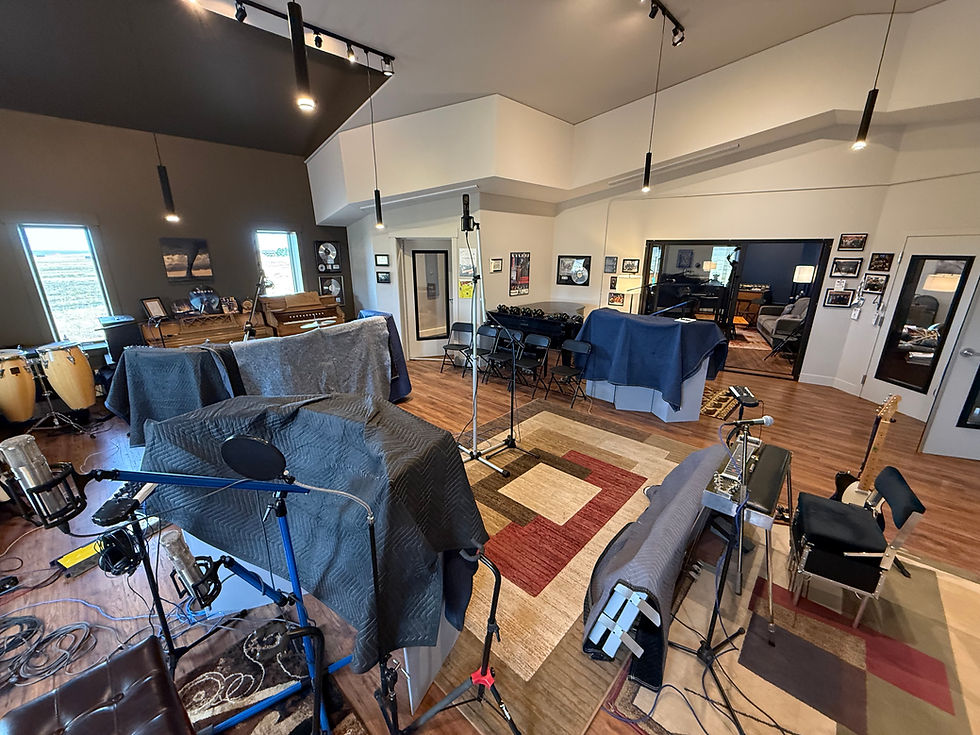
I'm proud that, at Timber Canyon Studios, we are running state of the art hardware and software and our DAW is Avid ProTools Ultimate HDX. We run it on a Mac Studio M4Max computer and have both an HDX card and a UAD Octo card hanging off of the Mac. We have an Antelope Galaxy 64 audio interface handling our conversion in and out of the DAW. By any measure, this is considered a state-of-the-art digital audio recording and mixing system. This might indicate that we are not living in the 1980s (or 90s) and are very much up to date with the latest and greatest technology. However.......

Our microphone collection spans the years from the 1950s to modern mics of the 2020s. Our outboard collection spans the years from the late 1970s to the present. We're running a fully analog SSL console that, while modern, is modeled after SSLs flagship consoles from the 1980s. Add to that our 1" 8 track Sony/MCI tape machine (from Mara Machines in Nashville) circa 1982 and I find myself gravitating to a workflow that feels very familiar and fits like an old pair of jeans.

Running recording sessions is made extremely easy from a workflow standpoint when you have an analog console. You absolutely do NOT need a console in 2026 to record BUT having one streamlines the workflow so well and gives you easy access to just about everything and lets you manage gain staging in a much better way. Everything you need to do when recording is easily accessible in an instant. Getting great sounds is a given when pairing up our mic collection with the the console or outboard preamps. The console or outboard EQ, dynamics inserted to the console wherever needed, even Bricasti M7 (OK, back then it would have been a Lexicon 224) hardware reverb on an aux on the console to provide 'comfort' to singers and others when recording. With such a nice recording space, we're not fighting weird artifacts from being in a small room, or a low ceiling, or a bunch of parallel reflective surfaces. All of this adds up to what I remember from my early days of recording at a few large studios in the NYC area in the 1980s (and before that was my home studio with 1/4" 8 track or Andy's home studio with 1/2" 8 track - but that's for another post). Very familiar territory. In this way, maybe I am living in the 80s a bit. Not in a 'get off of my lawn' kind of way but in an appreciative kind of way bringing the best of the foundational knowledge from a truly historic time for recorded music and combining it with the latest and greatest technology.
This leads me to fully embracing a hybrid workflow where we bring it all together. Track the rhythm section to tape and then dump it into ProTools for overdubs and mixing? OK with me. Track to ProTools and move some tracks onto tape and back to add some tape saturation and fullness? OK with me. Work completely inside of ProTools (aka 'in the box')? Also OK with me. The possibilities and permutations are endless. The sonic palette is broad and we've got all of the possibilities at our fingertips.
If you're looking to record your next album in a unique state of the art recording studio in the beautiful Rocky Mountains of Wyoming, reach out and let's discuss things.
Until next time. - Jim


Comments